

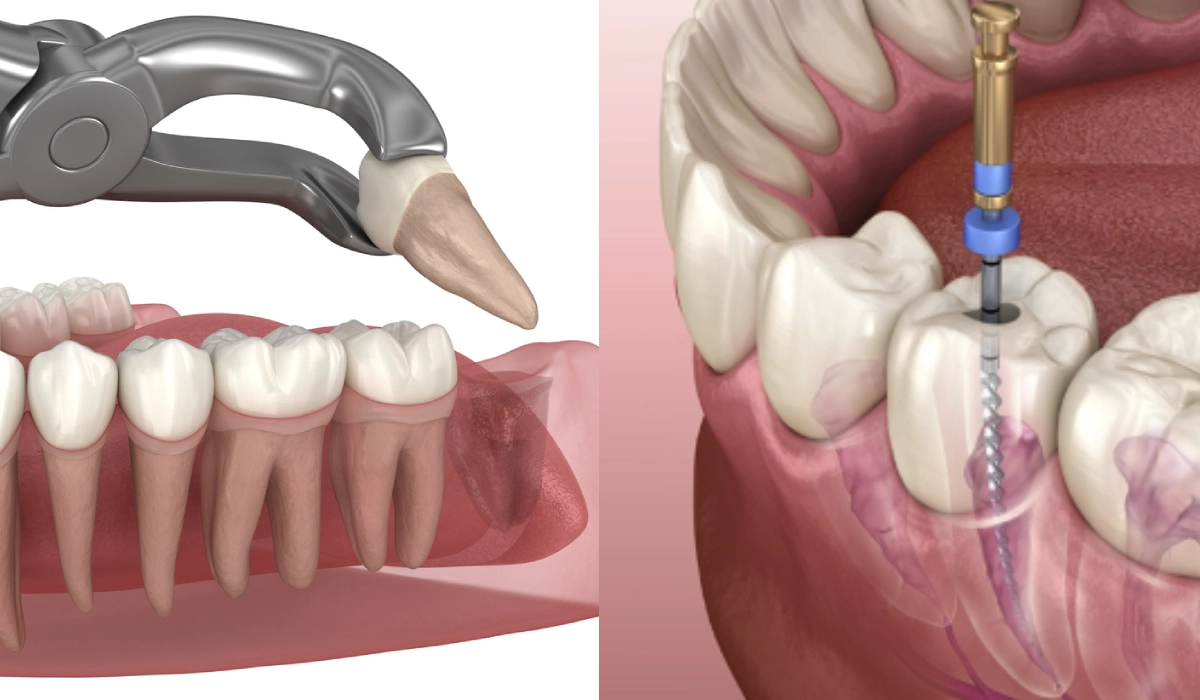
Facing a damaged tooth? The root canal vs extraction decision can be overwhelming. This guide helps you understand both options and choose the best treatment for your situation.
1. Should I Get a Root Canal or Tooth Extraction?
The choice between root canal vs extraction depends on several factors. Here’s how to decide:
When Root Canal is Recommended
Root canal is best if:
- Tooth structure is sound – Enough healthy tooth remains
- Single tooth problem – Infection limited to one tooth
- Good oral health – Healthy gums and surrounding teeth
- Long-term investment – Want to keep natural tooth
- Normal bite function – Tooth important for chewing
When Extraction is Recommended
Extraction may be better if:
- Extensive tooth damage – Too little healthy structure left
- Repeated root canal failures – Previous treatment unsuccessful
- Severe gum disease – Bone loss around tooth root
- Budget constraints – Cannot afford root canal + crown
- Patient preference – Wants definitive solution
Factors Your Townsville Dentist Considers
Clinical evaluation:
- X-ray analysis – Shows extent of damage and infection
- Tooth structure assessment – How much healthy tooth remains
- Bone level check – Support around tooth root
- Bite analysis – Importance of tooth for function
- Overall oral health – Condition of surrounding teeth
Patient factors:
- Age and lifestyle – Long-term treatment goals
- Medical conditions – Healing ability and surgical risks
- Financial considerations – Treatment and replacement costs
- Time availability – Multiple appointments vs single visit
Success Rates Comparison
Root canal success:
- Initial success rate: 85-95%
- 10-year survival: 85-90%
- 15-year survival: 80-85%
- With proper care: Can last lifetime
Extraction success:
- Immediate success: 95-98%
- Healing complications: 5-10% (dry socket, infection)
- Long-term satisfaction: Depends on replacement option
- No retreatment needed: Definitive solution
Age Considerations
Younger patients (under 40):
- Root canal preferred – Preserves tooth for decades
- Better investment – Natural tooth lasts longer
- Maintains jaw bone – Prevents bone loss
Older patients (over 60):
- Either option viable – Depends on individual factors
- Consider overall health – Healing capacity
- Treatment goals – Comfort vs longevity
At Townsville Dental Clinic, we evaluate each case individually to recommend the best treatment option.
2. What is Better – Root Canal or Extraction?
In most cases, saving your natural tooth with root canal treatment is better than extraction. Here’s why:
Advantages of Root Canal Treatment
Preserves natural tooth:
- Maintains original structure – No artificial replacement needed
- Natural chewing function – Full bite strength maintained
- Proper jaw alignment – Prevents bite problems
- Bone preservation – Keeps jawbone healthy
Long-term benefits:
- Cost-effective – Cheaper than extraction + replacement
- One-time treatment – Usually no retreatment needed
- No adjacent tooth damage – Unlike bridges
- Immediate function – Tooth works normally after healing
Advantages of Tooth Extraction
Immediate benefits:
- Complete problem removal – Eliminates infected tooth
- Lower initial cost – Less expensive upfront
- Shorter treatment time – Single appointment
- Definitive solution – No chance of root canal failure
When extraction is better:
- Severely damaged teeth – Cannot be restored
- Extensive bone loss – Tooth cannot be saved
- Patient anxiety – Prefers simple solution
- Budget limitations – Cannot afford root canal + crown
Comparison by Treatment Outcome
Root canal results:
- Keep natural tooth – Original tooth preserved
- Normal appearance – Tooth looks natural
- Full function – Can eat all foods normally
- Low maintenance – Regular dental care only
Extraction results:
- Missing tooth – Gap in smile initially
- Replacement needed – Implant, bridge, or denture required
- Ongoing maintenance – Replacement care needed
- Potential complications – Adjacent teeth may shift
Professional Recommendations
Dentists prefer root canals because:
- Preserves natural teeth – Always better than artificial
- Prevents future problems – Maintains proper bite
- Better patient outcomes – Higher long-term satisfaction
- Conservative treatment – Saves rather than removes
Extraction recommended when:
- Root canal not feasible – Too much damage
- Poor prognosis – Low success probability
- Patient cannot maintain – Poor oral hygiene
- Medical contraindications – Health issues prevent treatment
Patient Satisfaction Studies
Root canal satisfaction:
- 85-90% patient satisfaction – Most patients happy with results
- Would choose again: 80% would repeat treatment
- Improved quality of life – Pain relief and normal function
Extraction satisfaction:
- Varies by replacement – Depends on implant, bridge, or denture
- Initial relief – Immediate pain resolution
- Long-term concerns – About missing tooth consequences
Making the Decision
Choose root canal if:
- Tooth can be successfully treated
- You want to keep natural teeth
- Long-term value is important
- You can commit to proper care
Choose extraction if:
- Tooth cannot be saved
- Multiple root canal failures
- Severe anxiety about root canal
- Budget requires simpler solution
Most Townsville patients who choose root canal treatment are satisfied with preserving their natural teeth.
3. What Are the Alternatives to a Root Canal?
If root canal treatment isn’t right for you, several alternatives exist. Here are your options:
Tooth Extraction Alternatives
Simple extraction:
- Best for: Severely damaged teeth
- Procedure time: 30-60 minutes
- Recovery: 1-2 weeks
- Cost: $150-$400
Surgical extraction:
- For complex cases: Broken teeth, impacted roots
- Procedure time: 60-90 minutes
- Recovery: 2-3 weeks
- Cost: $300-$800
Tooth Replacement Options After Extraction
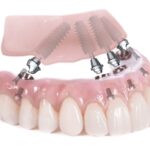
Dental implant:
- Most natural option – Looks and feels like real tooth
- Permanent solution – Can last lifetime
- Preserves bone – Stimulates jawbone
- Cost: $3,000-$5,000 total
- Timeline: 3-6 months treatment
Fixed bridge:
- Uses adjacent teeth – Requires grinding healthy teeth
- Permanent restoration – Cannot be removed
- Good appearance – Natural-looking results
- Cost: $3,000-$5,000 total
- Timeline: 2-3 weeks treatment
Removable partial denture:
- Most affordable – Least expensive option
- Removable – Take out for cleaning
- Adequate function – Some chewing limitations
- Cost: $800-$2,000
- Timeline: 2-4 weeks treatment
Conservative Alternatives to Root Canal
Pulp capping:
- For minor pulp exposure – Very early stage damage
- Preserves tooth vitality – Keeps tooth “alive”
- Success rate: 70-80% for appropriate cases
- Cost: $200-$400
- May prevent root canal – If successful
Pulpotomy:
- Partial pulp removal – Removes infected portion only
- For specific cases – Usually younger patients
- Temporary solution – May need root canal later
- Cost: $300-$600
Pain Management Without Treatment
Temporary relief options:
- Antibiotics – Control infection short-term
- Pain medication – Manages symptoms only
- Does not solve problem – Infection returns
- Emergency measure – Until definitive treatment
Risks of delaying treatment:
- Infection spread – Can become life-threatening
- Increased pain – Gets worse over time
- Tooth loss – May become non-restorable
- Higher costs – More expensive treatment needed
Alternative Treatment Locations
Dental schools:
- Student treatment – Supervised by faculty
- Reduced costs – 50-70% savings
- Longer appointments – More time required
- Quality care – Close supervision
Community health centers:
- Sliding scale fees – Based on income
- Basic treatment – May refer complex cases
- Limited options – Fewer alternatives available
Specialist referral:
- Endodontist – Root canal specialist
- Oral surgeon – Extraction specialist
- Higher costs – Specialist fees
- Expert care – Advanced techniques
No Treatment Option
Consequences of avoiding treatment:
- Chronic pain – Constant discomfort
- Infection spread – Serious health risks
- Tooth loss – Eventually requires extraction
- Emergency situations – Painful, expensive treatment
When people delay treatment:
- Fear of dental work – Anxiety about procedures
- Financial concerns – Cannot afford treatment
- Hoping it improves – Problems rarely resolve
- Busy schedule – Cannot find time
At Townsville Dental Clinic, we help you explore all alternatives and choose the best option for your situation and budget.
4. Is a Root Canal More Painful Than Tooth Extraction?
Both procedures are comfortable with modern anesthesia, but recovery experiences differ. Here’s what to expect:
During Procedure Pain Levels
Root canal procedure:
- Pain during treatment: 0-1/10 (with proper anesthesia)
- Procedure sensation: Pressure, vibration, no sharp pain
- Treatment duration: 60-120 minutes
- Anesthesia effectiveness: 95-98% complete numbness
Tooth extraction procedure:
- Pain during treatment: 0-1/10 (with proper anesthesia)
- Procedure sensation: Pressure, pulling, no pain
- Treatment duration: 15-60 minutes
- Anesthesia effectiveness: 95-98% complete numbness
Both procedures feel similar during treatment – No significant pain difference
Post-Procedure Pain Comparison
Root canal recovery pain:
- Day 1-2: 3-5/10 (moderate soreness)
- Day 3-5: 2-3/10 (mild discomfort)
- Week 1+: 0-2/10 (minimal pain)
- Pain type: Dull ache, tender when biting
Extraction recovery pain:
- Day 1-3: 4-6/10 (moderate to strong pain)
- Day 4-7: 3-4/10 (moderate discomfort)
- Week 2+: 0-1/10 (minimal pain)
- Pain type: Throbbing, jaw stiffness
Pain Management Effectiveness
Root canal pain control:
- Over-the-counter medication: Usually sufficient
- Ibuprofen + acetaminophen: Very effective combination
- Prescription medication: Rarely needed
- Duration: 3-7 days typically
Extraction pain control:
- Prescription medication: Often needed initially
- Stronger pain relievers: May require narcotics
- Anti-inflammatory drugs: Essential for swelling
- Duration: 5-10 days typically
Recovery Experience
Root canal recovery:
- Return to work: Next day usually
- Eating restrictions: Soft foods 24-48 hours
- Activity level: Normal activities
- Swelling: Minimal or none
Extraction recovery:
- Return to work: 1-3 days typically
- Eating restrictions: Soft foods 1-2 weeks
- Activity level: Limited first few days
- Swelling: Common, peaks day 2-3
Complications and Pain
Root canal complications:
- Flare-ups: 2-5% of cases
- Persistent pain: Rare with proper treatment
- Retreatment needed: 5-10% of cases
- Serious complications: Very rare
Extraction complications:
- Dry socket: 5-10% of cases (very painful)
- Infection: 2-5% of cases
- Nerve injury: Rare but possible
- Prolonged healing: More common
Patient Experience Reports
Root canal feedback:
- “Much easier than expected”
- “Back to normal quickly”
- “Manageable discomfort”
- “Glad I saved my tooth”
Extraction feedback:
- “More sore than anticipated”
- “Swelling was significant”
- “Needed time off work”
- “Happy it’s over”
Anxiety and Fear Factors
Root canal anxiety:
- Reputation worse than reality – Old myths persist
- Longer procedure time – Can increase anxiety
- Multiple appointments – Sometimes needed
- Success concerns – Worry about failure
Extraction anxiety:
- Permanent tooth loss – Finality causes worry
- Replacement decisions – Multiple options confusing
- Surgical procedure – Fear of surgery
- “Point of no return” – Cannot change mind later
Pain Prevention Strategies
For both procedures:
- Take medication before numbness wears off
- Follow post-treatment instructions carefully
- Use ice packs as directed
- Avoid hard foods initially
- Keep area clean but gentle
At Townsville Dental Clinic, we ensure both root canal and extraction procedures are comfortable with comprehensive pain management.
5. Can I Get an Implant Instead of a Root Canal?
Yes, you can choose extraction and implant placement instead of root canal treatment. Here’s what to consider:
Implant vs Root Canal Comparison
Dental implant option:
- Extract damaged tooth – Remove problem completely
- Place titanium implant – Artificial root in jawbone
- Attach crown – Natural-looking replacement tooth
- Timeline: 3-6 months total treatment
Root canal option:
- Save natural tooth – Preserve original tooth structure
- Clean infected tissue – Remove bacteria and damaged nerves
- Place crown – Protect treated tooth
- Timeline: 2-4 weeks total treatment
Success Rates Comparison
Dental implant success:
- Initial success rate: 95-98%
- 10-year survival: 90-95%
- 15-year survival: 85-90%
- Lifetime maintenance: Regular cleanings needed
Root canal success:
- Initial success rate: 85-95%
- 10-year survival: 85-90%
- 15-year survival: 80-85%
- Lifetime maintenance: Normal dental care
Cost Comparison
Implant treatment costs:
- Tooth extraction: $200-$400
- Implant placement: $1,500-$3,000
- Implant crown: $1,200-$2,000
- Total cost: $2,900-$5,400
Root canal treatment costs:
- Root canal procedure: $800-$2,000
- Crown restoration: $1,200-$1,800
- Total cost: $2,000-$3,800
Implant costs 30-50% more than root canal treatment
Treatment Timeline
Implant timeline:
- Day 1: Tooth extraction
- 2-4 months: Healing period
- Month 3-4: Implant placement surgery
- 3-6 months: Osseointegration (bone fusion)
- Month 6-7: Crown placement
- Total time: 6-8 months
Root canal timeline:
- Day 1: Root canal procedure (possibly crown prep)
- 2-3 weeks: Healing period
- Week 3-4: Crown placement
- Total time: 3-4 weeks
Advantages of Implants Over Root Canal
Long-term benefits:
- No root canal failure risk – Cannot get infected
- Excellent longevity – May last lifetime
- Maintains bone – Stimulates jawbone like natural tooth
- No special care needed – Clean like natural teeth
- Highest patient satisfaction – Most natural feeling
Advantages of Root Canal Over Implants
Preserves natural tooth:
- Keep original tooth – No artificial replacement
- Faster treatment – Weeks vs months
- Lower cost – Significant savings
- No surgery risks – Less invasive procedure
- Immediate function – Tooth works right away
When Implant is Better Choice
Choose implant if:
- Young patient – Want lifetime solution
- Root canal failed – Previous treatment unsuccessful
- Poor root canal prognosis – Low success probability
- Prefer definitive solution – Don’t want retreatment risk
- Excellent oral health – Good candidate for surgery
When Root Canal is Better Choice
Choose root canal if:
- Want to save natural tooth – Preserve original structure
- Need faster treatment – Cannot wait months
- Budget constraints – Lower cost important
- Medical conditions – Surgery risks too high
- Good root canal prognosis – High success probability
Factors Affecting Decision
Patient factors:
- Age and health – Younger patients better implant candidates
- Bone quality – Affects implant success
- Smoking status – Reduces implant success rates
- Oral hygiene – Critical for both treatments
- Anxiety level – Some prefer less invasive treatment
Tooth factors:
- Amount of healthy structure – Affects root canal success
- Root anatomy – Complex roots harder to treat
- Previous treatments – History affects outcomes
- Strategic importance – Key teeth better saved
Getting Expert Advice
Consultation should include:
- Comprehensive examination – Both options evaluated
- X-rays and imaging – Detailed assessment
- Success probability – For both treatments
- Cost breakdown – Complete financial picture
- Timeline explanation – Treatment schedules
At Townsville Dental Clinic, we provide unbiased advice about implant vs root canal options, helping you make the best choice for your specific situation.
Expert Treatment Planning in Townsville
Confused about root canal vs extraction? Townsville Dental Clinic provides comprehensive evaluations to help you choose the best treatment option for your dental health and lifestyle.
Our Townsville approach:
- Thorough examination of all options
- Honest assessment of success rates
- Complete cost breakdowns
- Personalized treatment recommendations
Ready for expert guidance?
- Free consultation available
- All treatment options explained
- Insurance coverage reviewed
- Flexible scheduling offered
Don’t let uncertainty delay your treatment. Contact Townsville’s trusted dental experts for personalized advice on your tooth-saving options.
Weighing root canal vs extraction in Townsville? Trust Townsville Dental Clinic for expert evaluation and honest guidance on the best treatment for your situation.