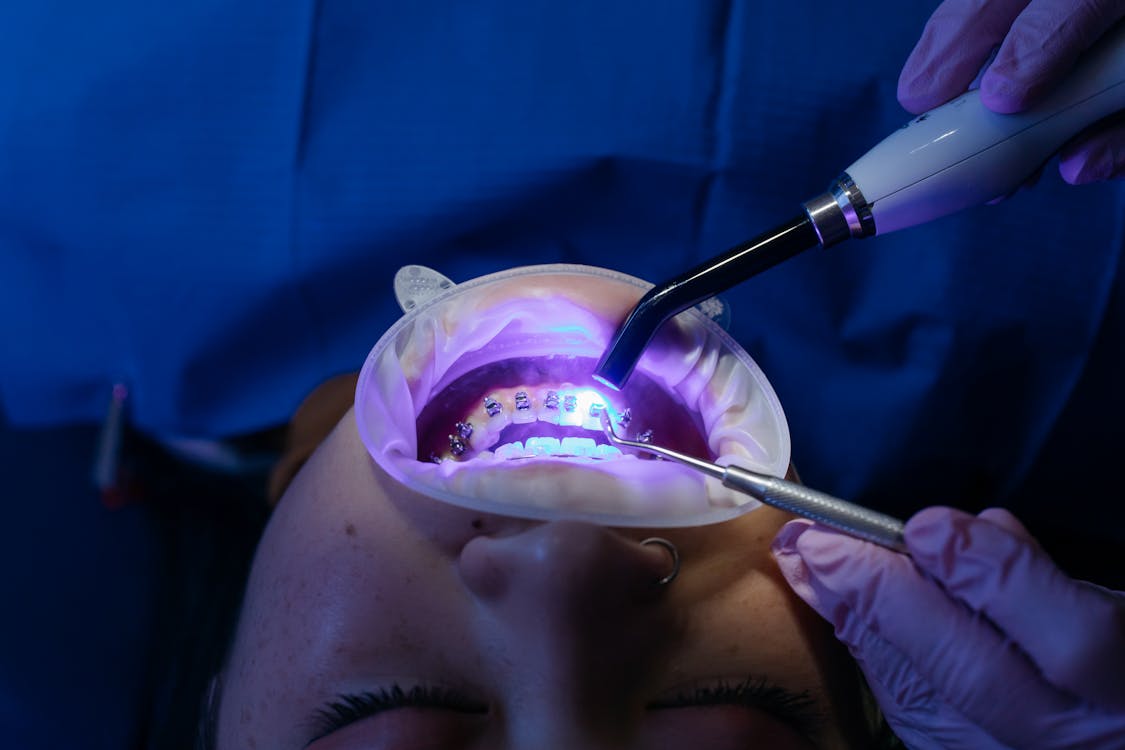
What Is Laser Teeth Whitening?
Laser teeth whitening is an in-office cosmetic procedure that uses professional-strength hydrogen peroxide gel activated by a specialised LED or laser light to remove deep stains and discolouration from tooth enamel, delivering results of 5 to 10 shades lighter in a single 60 to 90 minute appointment.
According to a systematic review in the Journal of Dentistry (Carey, 2014), professional in-chair whitening significantly outperforms over-the-counter products, with higher concentrations of active ingredients producing more uniform, longer-lasting results. The Australian Dental Association (ADA) recommends professional whitening as the safest and most effective approach, noting that dentist-supervised treatments use clinically tested products with proper gum protection.
A study in Operative Dentistry (2019) found no significant enamel structural damage when professional-grade whitening products were used as directed. In Australia, teeth whitening is one of the most commonly requested cosmetic dental procedures.
In Townsville, verified Townsville clinics use advanced laser whitening technology combined with pre-treatment desensitising protocols to deliver dramatic results with maximum comfort.
Quick Answer: Laser teeth whitening is a professional in-chair cosmetic procedure that uses high-concentration hydrogen peroxide gel activated by a specialised LED or laser light to remove deep stains and discolouration from tooth enamel. At verified Townsville clinics, a single session of 60 to 90 minutes typically lightens teeth by five to ten shades and costs between $500 and $900. According to a systematic review in the Journal of Dentistry, professional in-chair whitening significantly outperforms over-the-counter products in the degree and longevity of results, which last one to three years. A 2019 study in Operative Dentistry confirmed that professional-grade whitening gels produce no clinically significant enamel damage when used as directed. The Australian Dental Association recommends dentist-supervised whitening as the safest and most effective option. Custom take-home whitening trays are also available for gradual results at a lower cost.
How Does Laser Teeth Whitening Work?
The procedure follows a precise clinical protocol:
Step 1 — Preparation and Protection
We begin by examining your teeth and gums to confirm suitability. A protective barrier is applied to the gum tissue to shield it from the whitening gel. Your lips and cheeks are gently retracted for clear access to the teeth.
Step 2 — Whitening Gel Application
A professional-grade hydrogen peroxide gel (typically 25% to 40% concentration) is applied evenly across the front surface of the visible teeth. This is significantly stronger than over-the-counter products, which typically contain only 3% to 10% hydrogen peroxide.
Step 3 — Laser Light Activation
A specialised LED or laser light is positioned over the teeth to activate the hydrogen peroxide gel. The light energy accelerates the breakdown of hydrogen peroxide into oxygen radicals, which penetrate the enamel and break apart the chromogenic (colour-causing) molecules responsible for staining. Each activation cycle lasts approximately 15 to 20 minutes.
Step 4 — Repeat Cycles
The gel is removed and reapplied for 2 to 3 additional cycles during the same appointment, progressively lifting deeper stains with each cycle.
Step 5 — Post-Treatment Care
After the final cycle, the gel and gum barrier are removed. We apply a fluoride and desensitising treatment to reduce post-procedure sensitivity and strengthen the enamel. You leave the clinic with immediately visible results.
Total appointment time: approximately 60 to 90 minutes.
Laser Whitening vs Other Whitening Methods
| Method | Active Ingredient | Shade Improvement | Duration | Longevity | Supervision |
|---|---|---|---|---|---|
| Laser (in-chair) | 25-40% hydrogen peroxide | 5-10 shades | 60-90 minutes | 1-3 years | Dentist-supervised |
| Custom take-home trays | 10-22% carbamide peroxide | 3-6 shades | 1-2 weeks daily use | 6-12 months | Dentist-prescribed |
| Whitening strips (OTC) | 6-10% hydrogen peroxide | 1-3 shades | 2-4 weeks daily use | 3-6 months | Unsupervised |
| Whitening toothpaste | Abrasives + low-dose peroxide | 1-2 shades (surface only) | Ongoing daily use | While using | Unsupervised |
| Charcoal/natural remedies | Abrasives (no bleaching agent) | Minimal to none | Ongoing | Minimal | Unsupervised |
Source: Journal of Dentistry, 2014; Australian Dental Association consumer guidelines.
Professional in-chair laser whitening delivers the most dramatic, predictable results because it uses the highest safe concentration of hydrogen peroxide under direct clinical supervision with light activation technology that is not available in any take-home or over-the-counter product.
What Causes Tooth Discolouration?
Understanding why teeth become stained helps explain how whitening works and what results to expect.
Extrinsic Stains (Surface)
Caused by substances that accumulate on the outer enamel surface. These respond best to whitening:
- Coffee and tea — tannins bind to enamel and build up over time
- Red wine — chromogens and tannins create deep surface staining
- Tobacco — tar and nicotine produce yellow-brown deposits
- Cola and dark berries — acidic, highly pigmented compounds
- Poor oral hygiene — plaque and tartar accumulation
Intrinsic Stains (Internal)
Caused by factors within the tooth structure. These are more resistant to whitening:
- Ageing — enamel thins naturally, revealing the yellow dentin beneath
- Tetracycline antibiotics — taken during tooth development can cause grey-brown banding
- Excessive fluoride (fluorosis) — white or brown spots on enamel
- Trauma — injury to a tooth can cause darkening from internal bleeding
- Genetic factors — natural tooth shade varies between individuals
Who Is a Good Candidate for Laser Whitening?
Laser teeth whitening works best for patients who:
- Have healthy teeth and gums with no untreated decay
- Have extrinsic staining from food, drink, or tobacco
- Have natural teeth (whitening does not change the colour of crowns, veneers, or fillings)
- Are over 18 years of age
- Are not pregnant or breastfeeding
- Want significant results in a single appointment
Patients with intrinsic staining, very dark tetracycline discolouration, or extensive dental restorations may be better suited to alternative cosmetic treatments such as porcelain veneers or dental bonding. We assess suitability during your consultation and recommend the best approach for your specific situation.
Take-Home Professional Whitening Kits
For patients who prefer a gradual approach, we offer custom-fitted take-home whitening trays with professional-strength gel:
- Custom trays — fabricated from precise impressions of your teeth for a snug, leak-free fit
- Professional gel — significantly stronger than over-the-counter products (10-22% carbamide peroxide)
- Daily use — wear trays for 30 to 60 minutes per day for 1 to 2 weeks
- Results — typically 3 to 6 shades lighter
- Convenience — whiten on your own schedule at home
Many patients combine in-chair laser whitening with take-home trays for the best of both worlds: immediate dramatic results followed by maintenance and touch-ups at home.
How to Maintain Your Whitening Results
Professional whitening results can be extended significantly with proper aftercare:
- First 48 hours — avoid coffee, tea, red wine, dark sauces, berries, and tobacco (the “white diet” period when teeth are most porous)
- Ongoing care — brush twice daily with fluoride toothpaste, floss daily
- Limit staining foods — use a straw for dark-coloured drinks when possible
- No tobacco — smoking is the single biggest cause of re-staining
- Regular dental cleanings — professional cleaning removes surface stain buildup before it penetrates enamel
- Touch-up treatments — periodic use of take-home trays or an annual in-chair top-up maintains brightness
Laser Teeth Whitening vs Veneers for Discoloured Teeth
For patients considering both options:
| Factor | Laser Whitening | Porcelain Veneers |
|---|---|---|
| Best for | Extrinsic stains, mild-moderate discolouration | Severe intrinsic staining, tetracycline, shape/alignment correction |
| Procedure | Non-invasive, no tooth preparation | Requires removal of thin enamel layer |
| Time | 1 appointment (60-90 min) | 2-3 appointments over 2-3 weeks |
| Results | 5-10 shades lighter | Complete colour, shape, and alignment control |
| Longevity | 1-3 years (with touch-ups) | 10-15 years |
| Reversibility | Fully reversible | Irreversible |
| Cost | $500-$900 | $1,200-$2,500 per tooth |
| Maintenance | Periodic touch-ups | Standard oral hygiene |
The Australian Dental Association recommends starting with the least invasive option. Laser whitening is the appropriate first step for most patients with staining concerns.
Further reading
Related Services
Ready to book? Compare clinics
Frequently asked questions
How many shades whiter can laser teeth whitening achieve?
Professional in-chair laser whitening at verified Townsville clinics can lighten teeth by 5 to 10 shades in a single 60 to 90 minute appointment. Results vary depending on the type and severity of staining. Intrinsic staining caused by tetracycline antibiotics or fluorosis may require multiple sessions or alternative treatments such as veneers.
How long do laser teeth whitening results last?
Professional laser whitening results typically last between 1 and 3 years, depending on diet, oral hygiene habits, and tobacco use. A systematic review published in the Journal of Dentistry found that in-office whitening maintained clinically significant colour improvement at the 12-month follow-up in over 80% of patients. Periodic touch-up treatments and good oral hygiene extend results further.
Is laser teeth whitening safe for your teeth?
Yes. When performed by a qualified dentist using approved professional-grade products, laser teeth whitening does not damage tooth enamel. A 2019 meta-analysis published in Operative Dentistry concluded that professional hydrogen peroxide whitening gels at concentrations up to 40% produced no clinically significant enamel structural changes. The Australian Dental Association advises that professional whitening carries far lower risks of sensitivity and gum irritation than unregulated over-the-counter products.
Does laser teeth whitening hurt?
Most patients experience no pain during the procedure. Some patients report mild, temporary tooth sensitivity for 24 to 48 hours afterwards, which typically resolves on its own. We apply a desensitising agent before and after treatment to minimise sensitivity. Patients with pre-existing sensitivity should discuss this during their consultation.
How much does laser teeth whitening cost in Townsville?
Professional in-chair laser whitening at verified Townsville clinics typically costs between $500 and $900 per session. Take-home whitening kits with custom trays range from $300 to $500. We provide an exact quote during your consultation. Some private health insurance policies with extras cover may provide a partial rebate for whitening when clinically indicated.
Who should not get laser teeth whitening?
Laser teeth whitening is not recommended for pregnant or breastfeeding women, children under 18, patients with untreated tooth decay or active gum disease, those with very dark intrinsic staining from tetracycline, or patients with hypersensitivity disorders. A dental assessment is required before treatment to confirm suitability.
What is the difference between laser whitening and take-home whitening?
Laser (in-chair) whitening uses a higher concentration of hydrogen peroxide activated by a specialised light for immediate results in one appointment. Take-home whitening uses a lower concentration gel in custom-fitted trays worn for 30 to 60 minutes daily over 1 to 2 weeks. Laser whitening produces faster results while take-home whitening offers gradual improvement at a lower cost. Many patients combine both methods for optimal outcomes.
Can laser whitening remove stains from coffee and red wine?
Yes. Laser teeth whitening is highly effective at removing extrinsic stains caused by coffee, tea, red wine, cola, berries, and tobacco. These surface stains respond best to professional whitening. Intrinsic stains embedded within the tooth structure are more resistant and may require alternative cosmetic treatments.
Popular Townsville treatment cost guides
Useful next pages
Also browse
- Scale and Clean in Townsville — 2026 Cost ($150-$250) & Clinics
- Best Children's Dentists Bundaberg 2026
- Oral Health Assessment Cost Bundaberg 2026
- Bone Grafting Cost Bendigo 2026
- Sports Dentistry Cost Bendigo 2026
- Chipped Tooth Repair Cost Busselton 2026
- Best Cosmetic Dentists Albury–Wodonga 2026
- Fissure Sealants Cost Albury–Wodonga 2026
Townsville clinics listing this service
67 clinics list this service in the directory.
Need to compare local options?
Use the directory filters before contacting a clinic for current availability, fees, and treatment advice.